A Practical Guide to Strategic AI-Enhanced Workflow Automation with No-Code
March 24, 2026, by Alex Puttonen
AI-enhanced Automation is Here to Stay
AI now dominates discussions in enterprise process management. Recent McKinsey research shows that 94% of employees and 99% of C-suite are now familiar with generative AI tools.
For business and technology leaders, the question now isn't whether to adopt AI, it's how to embed it meaningfully into the workflows that already run your business.
Too often, AI is layered on as a standalone experiment. While this may result in impressive demos, limited operational impact can grow executive skepticism. It's crucial to understand the relationship among workflows, automation, and AI and how to align them to best advantage.
By mastering these foundational concepts, you'll be better equipped to approach automation strategically and align it with your organizational goals.
Digital Workflows vs. Automation vs. AI: Why the Distinction Matters
As new technologies democratize process management in the enterprise, these terms are sometimes used interchangeably. This can create confusion and, sometimes, misaligned investments. To ensure your success, let's define these distinct elements:
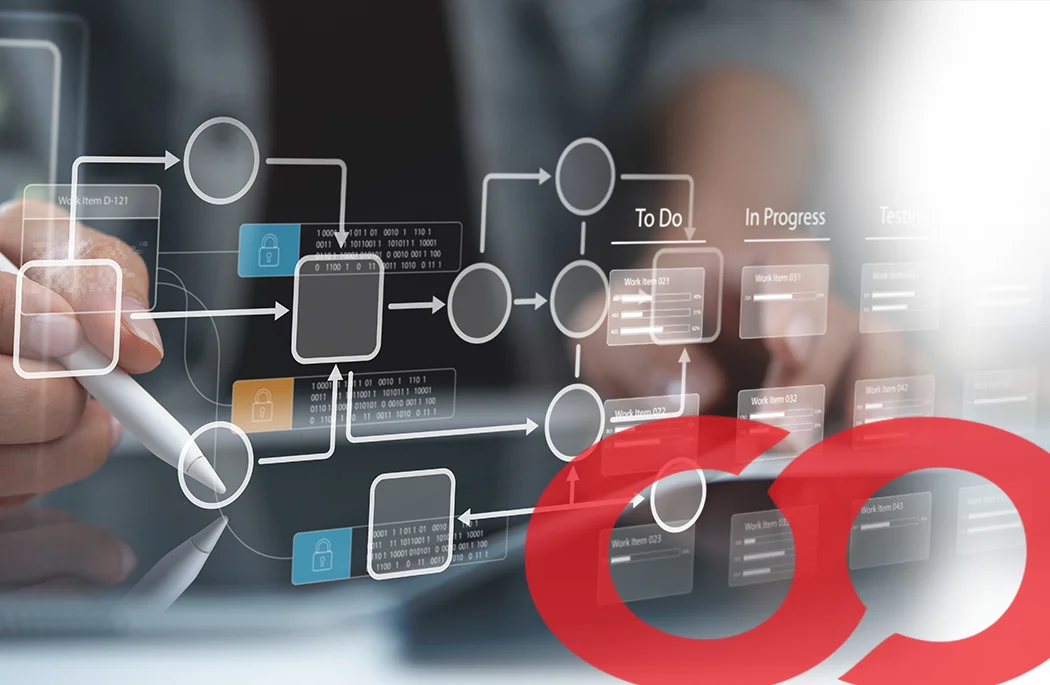
Workflows, whether digital or physical, are the structural building blocks of your business processes. Mapping out your workflows organizes the work: who does each task, required approvals, data flows, and expected outcomes. Workflows provide a blueprint for consistent execution, creating order and governance through both manual and automated steps.
Automation, by contrast, is the execution layer. It performs predefined, rule-based tasks or record escalations within the workflow. It sends notifications, updates records, routes forms, and synchronizes data between systems. Automation excels at speed and precision because it follows structured logic. What it cannot do is interpret ambiguity or adapt to nuance.
That's where AI enters the picture. AI introduces intelligence and adaptability into structured processes. When prompted it can analyze record histories, generate summaries and reports, or recommend potential actions based on patterns in historical data relevant to the user.
The most effective enterprise strategy is to layer these elements intentionally: begin with a defined workflow, automate repetitive high-volume tasks, then add AI where it delivers measurable value through contextual summarization or helping users with analysis to aid decision making.
When organizations skip the workflow foundation and jump straight to AI, they often discover that intelligence without structure simply creates accelerated chaos.
Want a strategy tailored to your business?
Flowfinity experts can help you map your processes,
automate the right steps and deploy AI.
No-Code as a Strategic Enabler of Digital Transformation
The key is to begin with a business problem, not a technology experiment.
For many organizations the barriers to AI adoption are technical capacity and change management. An agile, incremental approach to implementing AI usage is a better way to get results sooner, encourage adoption, and mitigate IT resource constraints. Flowfinity's no-code platform addresses these challenges head-on, fundamentally shifting the equation.
No-code is not just a buzzword or a toolset. It's becoming the dominant strategic approach to digital transformation. Gartner estimates that in 2025, 70% of new applications developed by organizations leveraged low-code or no-code technology, up from 20% in 2020. This growth is driven by demand for simpler, faster application deployment and improved no-code tools.
Platforms like Flowfinity move organizations from code-first to process-first thinking. Instead of waiting for developers to build and test, business teams closest to their processes can create automated workflows using point-and-click tools, reusable templates, and secure integrations.
The advantages are significant. Faster deployment cycles, more agile business units, and improved IT governance. Organizations can build applications, automate workflow triggers, and connect systems without needing custom expertise for each change as processes evolve.
When AI is introduced into this environment, the impact multiplies. Rather than deploying AI as a separate application, it should be embedded directly into existing workflows:
- An engineer can automatically generate a correctly formatted stakeholder report from structured inspection data.
- A field technician performing an asset repair can review an AI-generated summary of historical service records.
- A water utility supervisor can receive real-time anomaly alerts in context generated from integrated IoT sensor streams.
Because all these capabilities are built-in to Flowfinity's central platform, they remain aligned with enterprise security policies, role-based access controls, and data ownership requirements.
Getting started does not require a massive transformation initiative. Flowfinity experts can help you define clear objectives, map your workflows, automate, and implement AI without code.
Designing Effective AI-Enabled Digital Workflows
Technology alone does not create efficiency. Thoughtful design does.
Before automating anything, organizations should conduct a process analysis. Mapping workflows to identify participants, data sources and bottlenecks are foundational steps. This activity will reveal where repetitive tasks, high-volume activities, or manual data entry are creating friction where your process can benefit most from automation.
Additionally, you can use external AI analysis to speed up the workflow discovery phase by laying out potential scenarios that can be quickly mocked up and tested using no-code tools before selecting the final iteration for deployment.
Once the workflows for automation are identified, integration becomes the next consideration. Effective data integration can consolidate information from multiple systems and enable real-time processing by AI while ensuring consistency.
In a Flowfinity context, this means users can securely call upon AI services to generate structured outputs from data sources and log results directly into system records. The AI assistant doesn't operate in isolation, it becomes part of a controlled, auditable business process controlled by you.
As organizations manage information across multiple systems, centralized data management practices help maintain consistency and integrity. AI should never bypass established security boundaries. It should respect role-based access controls, authentication policies, and data governance frameworks, just as any other enterprise system does.
When designed correctly, AI-enhanced workflows deliver tangible outcomes. Engineers improve reporting speed and accuracy. Field service teams reduce troubleshooting effort. Utilities detect anomalies faster and respond proactively.
In every case, workflow establishes structure, automation enables consistent execution, and AI assistants enhance summary and analysis for decision-making.
Moving from AI Experimentation to Operational Value
For business and IT leaders, the mandate is clear. AI must move from isolated pilots to embedded operational capability.
This transformation requires clarity around foundational concepts, a strategic commitment to no-code agility, disciplined process analysis, and reliable data integration practices. When those elements align, AI stops being a standalone feature and becomes an operational asset.
The future of enterprise AI is about embedding intelligence directly into the workflows where real work happens at scale.
Finding success begins by identifying a business problem and defining what measurable outcomes would prove success. Then map workflows to discover where automation and AI can add value. Finally adopt a no-code approach to application development and integration to refine the solution iteratively until you achieve operational impact.
Flowfinity experts are here to help. You may also want to read about deploying AI with guardrails to ensure data accuracy or explore how to structure a successful AI pilot project.